Kemet, Egypt, Misr, or Kuma; what did those who lived along the banks of the Nile River north of the 22nd parallel call their land and themselves?

 _km_, Kemet, Kuma, from the Harris Papyrus, Late Kingdom Hieratic, written from right to left _km_, Kemet, Kuma, from the Harris Papyrus, Late Kingdom Hieratic, written from right to left
|
|
|
The stats for THE NEW TIMES HOLLER! has a section called ?Key Phrases,? phrases that people type into their browsers to search for information. There are many references to Kemet:
List the timeline of kemet leading up to the name change of Egypt
Ancient Kemet astrology
Kemetic rituals for summer solstice
Kemetic astrology reading
Ancient Kemet days names
Kemet and Rama
Kemetic alignment chart weekly
Calendar after the foundation of Kemet
Sometimes the use of Kemet is imposed. I found the title of my article The Ancient Egyptian Foundations of Western Astrology ?corrected? to The Ancient Kemetic Foundations of Western Astrology on a few sites.
While there is extensive knowledge of the written language of the ancient Nile dwellers, there is less certainty about its pronunciation. Because vowels were rarely written for Egyptian/Kemetic words and names.
What we do know is derived from our knowledge of the Coptic language, which is a descendant of ancient Egyptian, and some important clues left by diplomatic communiqués between Mesopotamia and Egypt. Egyptian, as most Egyptologists call the language, was a member of the Afro-Asiatic language family,
and has its closest connections with Coptic, Berber, Cushitic, Chadic, and Semitic languages such as Arabic and Hebrew, found in North Africa, Mali, Ethiopia, and the southern and eastern Mediterranean regions.
TA-MERI
Here are two names that they called their land that have come down to us: Kem,  - the black land and Ta-meri,
 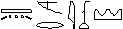 - the beloved two lands. While there is the ?letter? T (the hieroglyph at the upper right) at the end of kem, it wasn?t pronounced, but was an indication that kem was a feminine word. Kem, the hieroglyph on the left, a crocodile's skin with spines (crocodile hide?), was also used for the color black, and combined with the sign for "cross roads" at the bottom right, refers to a black locality, land, or country. ?Black Land? describes the color of the rich soil along the banks of the Nile.
?The beloved two lands? refers to Upper and Lower Egypt, which were originally two separate kingdoms before they were united under King Narmer. From that time on, Pharaohs were referred to as rulers of "the two lands". - the beloved two lands. While there is the ?letter? T (the hieroglyph at the upper right) at the end of kem, it wasn?t pronounced, but was an indication that kem was a feminine word. Kem, the hieroglyph on the left, a crocodile's skin with spines (crocodile hide?), was also used for the color black, and combined with the sign for "cross roads" at the bottom right, refers to a black locality, land, or country. ?Black Land? describes the color of the rich soil along the banks of the Nile.
?The beloved two lands? refers to Upper and Lower Egypt, which were originally two separate kingdoms before they were united under King Narmer. From that time on, Pharaohs were referred to as rulers of "the two lands".
It should be noted that people named their countries and themselves or were described by others from geographical characteristics ("Land where the Sun Rises - A Chinese description of Japan), or legendary figures (Gikuyu for Kikuyu and Romulus for Rome) and not after skin color until the era of modern colonialism.
Because Egyptian was written without vowels, we can exaggerate and say that _km_ could have been akomia, kuomi, or okoma! So, the ?Kemet? now in use is derived from the consonantal skeleton, which was not the spoken form.
WHAT DID THEY CALL THEMSELVES?
From the Illahun Papyri, which were found near the tomb of Pharaoh Senusret II 1897-1878 BCE, and dated during the Middle Kingdom period, we find the word for people was  _rmT_ (remetch?) or _rm_, and there are texts where they used the same word for themselves, simply ?The People? . _rmT_ (remetch?) or _rm_, and there are texts where they used the same word for themselves, simply ?The People? .
Sometime ago I asked
James P. Allen, Curator of Egyptian Art at the Metropolitan Museum of Art about this, and in an Email, he said that the Coptic vocalization was r?m?nkEme, pronounced ?Rem-en-KAYmeh? [the ?en?  means ?of"]. He suggested that during the Middle Kingdom onwards, it was probably pronounced *rama-ni-KUma means ?of"]. He suggested that during the Middle Kingdom onwards, it was probably pronounced *rama-ni-KUma  In terms of sound, it seems more likely that a people of that part of the world would call themselves ?Rama ni Kuma? than Kemetics; the suffix ic is a kind of Latin/French thing: Atlantic, futuristic, etc. In contrast, one can hear the rhythm and sound of Afro-Asiatic in Rama ni Kuma.
HOW/WHEN "EGYPT"?
Later, after the New Kingdom, they referred to their land by the name of one of their principle temples, Hwt-ka-ptah,  or the ?House of the Ka of Ptah, one of its most ancient gods. It is theorized by some that the Greeks couldn?t pronounce the h correctly at the beginning and end (most Americans can?t either; it?s easier to say Kemet!), and changed it to "Aegyptos", which can be found as far back as Homer?s Odyssey, before the Macedonian invasion. or the ?House of the Ka of Ptah, one of its most ancient gods. It is theorized by some that the Greeks couldn?t pronounce the h correctly at the beginning and end (most Americans can?t either; it?s easier to say Kemet!), and changed it to "Aegyptos", which can be found as far back as Homer?s Odyssey, before the Macedonian invasion.
It seems that there are different functions and projections for the various names, including the Arabic Masr, which simply means ?Country?, and also ?Garrison?. The ancient prounciation can be heard in modern Coptic's Kimi and Sahidic Coptic's Keme.
While the use of Kemet and Kemetic is meant to evoke and continue Kuma's proud history, if one wants to approximate the sound of Egyptian, practice Coptic, Arabic or Chadic sounds.
|
|
|
|
|