REMEMBERING RICHARD MASATO AOKI
~As an informer for the FBI~
Special for THE NEW TIMES HOLLER!
by
© Amir Bey, 2009 June 6
Updated August 22, 2012
|
New revelations that the legendary San Francisco Bay Area activist, the late Richard Masato Aoki, had been an FBI informant since the late 50s have emerged recently.
This information came from research by
Seth Rosenfeld, a San Francisco Chronicle Staff Reporter, and Center for Investigative Reporting writer. He has been working on a book, Subversives: The FBI's War on Student Radicals, and Reagan's Rise to Power. The book, based on research spanning three decades, was published Tuesday, August 21, by Farrar, Straus and Giroux.
The Holler! decided not to delete or alter the original text from its June 6, 2009 article below. Instead, the new information has been added as an intro to the article, so that readers can see how the misplaced trust and admiration for Aoki is an instruction on how an informant can influence those they come in contact with.
|
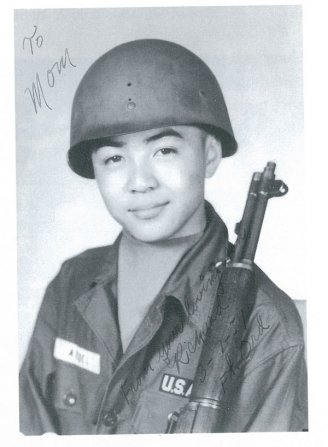
Aoki joined the army after leaving high school, telling friends he wanted to become the first Asian American 4-Star General. He had already begun informing for the FBI,initially to spy on local communists. Later, While attending Merritt College in Oakland, he joined the youth branch of the Socialist Workers Party and was an informer for the FBI.
|
RICHARD AOKI
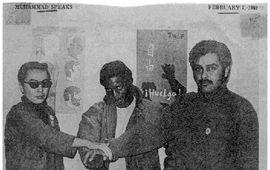
University of California Berkeley Leaders of the 3rd World Liberation Front: Richard Aoki, Asian American Political Alliance; Charles Brown of the African American Students Union; and Manuel Delgado of the Mexican American Students Union. |
Berkeley, CA. This photo appeared in Muhummad Speaks, 2/7/69
|
It has been said that there were instances when informants often outnumbered Party members. Aoki is an example of how deep the infiltration of the Party was. One of their highest ranking officers, a "Field Marshall of Self Defense," was working against them, and was a trusted comrade even after his passing.
When the article below was written it was known by me, nor had there been any public information that Aoki had committed suicide because of his long-term fight against kidney disease. One may speculate on whether Aoki had other anxieties besides his physical health that drove him to suicide.
Aoki may have been of two minds - or hearts: he was a conflicted man who, as an FBI informer against the Black Panthers was part of the overwhelming destruction of the effectiveness of the Black Panthers by the FBI's COINTELPRO (Counter Intelligence Program). But he must have felt an affinity with those he informed against.
There was certainly a high level of involvement that he was engaged in with the various groups, particularly the Panthers, with whom he attained a high rank and prestige that was legendary. His collusion with the FBI was only part of the story, and since they got to him during his high school years, it was an abusive condition not unsimilar to a drug addiction.
There are still thousands of pages from FBI files on Aoki that have not been opened. Because Aoki supplied and trained the Panthers in the use of guns from his "collection," the question has to be asked if the FBI knew and supported it. Most likely. What was their strategy? To provoke and entrap the Panthers? "They want guns? Give 'em guns; they'll be right where we want 'em!" Aoki's handler said he was one of their best, and to give the Panthers guns, is a cynical, shrewd tactic because there would be no competition against the fire power and training of local and federal authorities.
Here is a quote from Aoki during an interview with Rosenfeld that appeared in the SF Chronicle this past August 20:
In 2007, two years before he committed suicide, Aoki was asked in a tape-recorded interview for the book if he had been an FBI informant. Aoki's first response was a long silence. He then replied, "'Oh,' is all I can say." Later during the same interview, Aoki contended the information wasn't true. Asked if this reporter was mistaken that Aoki had been an informant, Aoki said, "I think you are," but added: "People change. It is complex. Layer upon layer."
The FBI later released records about Aoki in response to a federal Freedom of Information Act request made by this reporter. A Nov. 16, 1967, intelligence report on the Black Panthers lists Aoki as an "informant" with the code number "T-2." An FBI spokesman declined to comment on Aoki, citing litigation seeking additional records about him under the Freedom of Information Act.
Here is a detailed video presenting the case against Richard Masato Aoki, The Man Who Armed The Panthers.
HERE IS THE ORIGINAL HOLLER! ARTICLE
All the blessings to Field Marshal Richard Aoki, dedicated activist, educator, friend
November 20, 1938-March 15, 2009
"Based on my experience, I've seen where unity amongst the races has yielded positive results. I don't see any other way for people to gain freedom, justice, and equality here except by being internationalist." Richard Aoki
When I attended Grove Street College, The Peoples' College, officially called North Peralta Community College, I was a Black Studies major, and just beginning to understand who I was as an artist. I encountered many educators who were influential to my development: the painter Claude Clarke Sr., the multi talent from Mali, Saribou Kone, painter David Hernandez, sculptor William Lem, my counselors, Jaime Soliz and Richard Masato Aoki. .
|
RICHARD AOKI
IN LATER YEARS |
Oakland, CA

|
I enjoyed going to Richard's office, because in our discussions he informed me about many things, about his early years in the interment camp for Japanese Americans in Topaz, Utah, about the history of Asian Americans in California, social contradictions. I remember him as a slight, short man; very similar to the 3rd
World Liberation Front photo at the top, except at Grove Street he wore suits instead of a leather jacket and shades.
Actually, my sense of him was less as the warrior, and more like a seed-sewing socially conscious activist.
I dug his intellect, ironic humor, his sharp insights, someone I felt an afinity with. Years afterward, I?d talk about him to others, because our friendship, although only taking place in his office, was beneficial, contributing to my return to urban America after living in the mountains for two years.
|
Richard (left) and his younger brother David
|
At the Japanese American interment camp
Topaz, Utah, circa 1942

|
I was in my early 20s, knocking around; after leaving New York for California, I?d lived at Black Bear Ranch, Covelo, and other places, and then returned to the Bay Area, to go to Grove Street College as the community called it. The school had quite a history. When it was Merritt Community College and from the surrounding community, the Black Panther Party for Self Defense had its origins, and it was where ethnic studies were flourishing. Its spirit was one of activism. I decided I wanted to learn an African language, thinking that by learning Kiswahili I would acquire a linguistic tool that would help me cope in the USA?s European dominated society. How wrong I was about European dominated! ?America?
has always been a multi-ethnic society, and it was here at the People?s College, that I learned this.
|
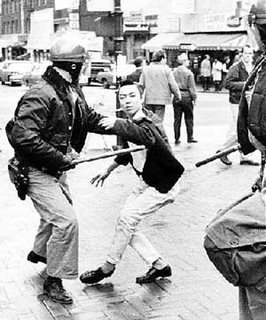
Richard Aoki being arrested at a 3rd World Liberation Front Demonstration, Berkeley, 1969. |
"I believe in mass action"
|
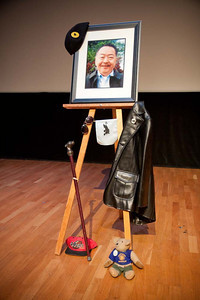
From Richard's memorial that was held on May 2, 2009 held at Wheeler Auditorium, University of California, Berkeley |
A Black Panther Field Marshall Remembered
|
I hadn?t seen him since 1975, but he had made a lasting impression on me, and my thoughts would occasionally go back to him. These past few weeks I?d been thinking about him more than usual and decided to Google his name to see wassup. I had a shock and a surprise: shocked that he had just passed away this past March 15 from long standing illnesses, and surprise, that he was a Field Marshal in the Black Panther Party of Self Defense.
He was one of its first members, an eight year Army vet who was trained as an expert in sharpshooting and small arms and was instrumental in training Panthers how to use guns. According to Party Chairman and co-founder Bobby Seale, Aoki helped organize some of the Party?s first rallies against police brutality and gave them guns from his personal collection that was used to patrol the police in the early days of the party. It wasn?t known that Richard was a member of the Black Panther Party until the early 1990s,
?That I was a field marshal is one of the biggest secrets?,? said Aoki, one of six Asian members out of 5,000 Panthers, and the only one of such a high rank. After his family left the interment camp they moved to the Oakland. He knew Bobby, Huey Newton and David Hilliard and their families while growing up in Oakland and later, when he had embraced Marxist Leninist philosophy, Bobby and Huey showed him a draft of the 10 point program of that was later adopted by the Party.
Richard rejected the idea of Asians as the "model minority" and felt that Asian Americans should recognize the common causes they had with other social groups; he was a leader of the University of California Berkeley?s 3rd World Liberation Front.
During a 1969 demonstration in Berkeley he was armed with a wood staff and sent two policemen to the hospital.
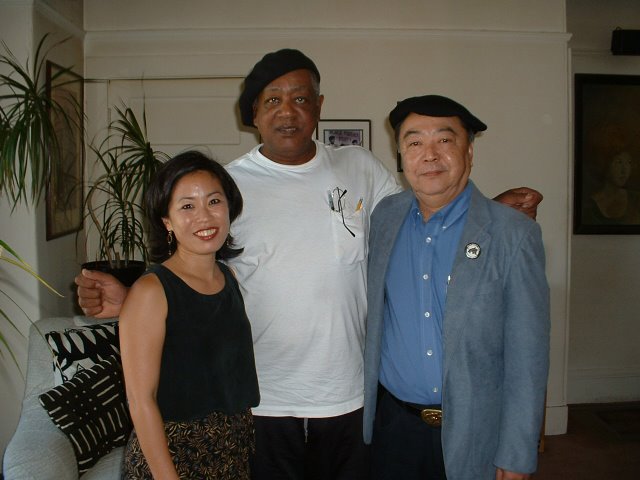
Dr. Diane Fujino (his biographer), Bobby Seale, former chairman of the Black Panther Party, Richard
|
In Good Company
|
As a dedicated community organizer, educator, and inspirational force, he will long be remembered. Be on the lookout for an upcoming documentary about him by Ben Wang and Mike Cheng;
here is a trailer for it.
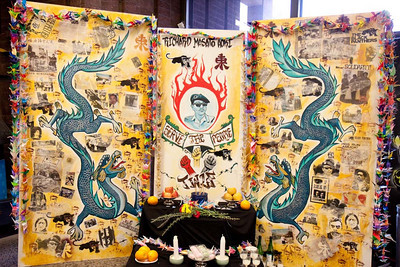
A shrine commemorating Richard Aoki that was presented at his memorial on May 2, 2009, Berkeley, California.
|
|
|
|
Thank you Richard. All praises due! |
Black Panther Party for Self Defense
Field Marshall Richard Masato Aoki
|
|
|
|
|
|